An architectural redesign of the democratic process. By decoupling party registration from participation and introducing ranked preference, we restore agency to the individual and stability to the institution.
Moving from binary conflict to a multi-dimensional preference model.
Measured across implementation zones using standardized civic metrics.
Highest engagement recorded in non-presidential mid-cycle windows.
Significant increase in multi-partisan collaboration incentives.
A single unified ballot featuring all candidates regardless of party affiliation. Every voter participates. The top finishers advance, ensuring the general election represents the entire constituency.
Voters rank candidates in order of preference. If no one secures a majority, the least popular candidate is eliminated, and their votes flow to the next choice. This continues until a consensus is reached.
No "Wasted Votes"—consensus built through iterative elimination.
Download the legislative toolkit for your municipality and join the architectural review of modern democracy.
Two simple upgrades. A dramatically better result.
Today's political system (Voting 1.0) is giving us polarized candidates, negative campaigns, and a system where most Iowans feel like their vote doesn't matter. But the fix isn't complicated. We call it Voting 2.0 — and it's already working in cities and states across the country.
upgrade 1
Single Open Primaries
upgrade 2
Ranked Choice Voting
All the candidates appear on a single ballot. All voters participate, regardless of party affiliation. You vote for your one favorite candidate, and the top five vote-getters advance to the general election.
How Single open primaries work
Pick your favorite candidate
In the primaries, voters choose their favorite from a ballot that includes candidates from all parties. The five candidates with the most votes move forward to the general election.
Why Single Open Primaries Work
When candidates have to appeal to all voters — not just the most passionate members of their party — they run more civil, more substantive campaigns. And with five candidates advancing instead of one, Iowans finally have real choices.
Iowa Voters
An equal voice for independents.
Independents, who represent 35% of Iowa voters, would finally have an equal voice in choosing who appears on the general election ballot.
Iowans Want More
8 in 10 Iowans want more options.
8 out of 10 Iowa voters want more options on the ballot. Voting 2.0 gives us that.
Under Voting 2.0, Iowa voters rank candidates in order of preference.
If your top candidate gets the fewest votes, your vote automatically goes to your next choice. This continues until one candidate wins a true majority.
Why Ranked Choice Voting Works
Ranked Choice Voting elections can find the most popular candidate, even when voters can't agree on their first choice. That means more candidates can run without "spoiling" the election, and voters can vote their conscience without feeling their vote is "split" between two good options.
Candidates can't win by going negative or writing off voters they disagree with — they need to earn broad support. They're accountable to the voters — all of us. Even voters who rank them second or third matter. That changes how campaigns are run, and ultimately, who gets elected.
How rank choice voting works
Rank up to 5 candidates. Fill only one oval in each column.
Mark your first choice, then keep ranking. Your vote for #1 counts first, it only will move to your next choice if your higher ranked choice cannot win.
Your #1 vote is NEVER wasted. It only moves to the next choice if your previous choice is eliminated!
That pit in your stomach when you cast your vote for the lesser of two evils? Gone. Your vote actually reflects what you want.
What if candidates actually had to compete for your vote? Not by scaring you away from the other guy — but by showing up in your community, telling you what they stand for, and making the case for why they deserve your support. That's what Voting 2.0 makes possible.
Pete Jones
Board Member, Better Ballot Iowa
Tested. Proven. Works.
Open primaries and ranked choice voting are already in use across the country. We have decades of experience and data - and the results speak for themselves.
Example
Alaska voters have repeatedly chosen to keep their Voting 2.0 system in place, despite repeal attempts.
In 2025, Alaska Governor Mike Dunleavy vetoed an education funding package that was widely popular with Alaskan voters. Because Alaska's lawmakers were accountable to voters — not party insiders — they banded together across party lines, overrode the governor's veto with a 77% supermajority, and delivered what their constituents had asked for.
Example
Before upgrading their election system, Maine regularly saw governors elected with less than 40% of the vote — meaning the majority of voters' preferred candidate lost.
Since adopting ranked choice voting, winners must earn true majority support. And the transition hasn't been complicated:
Example
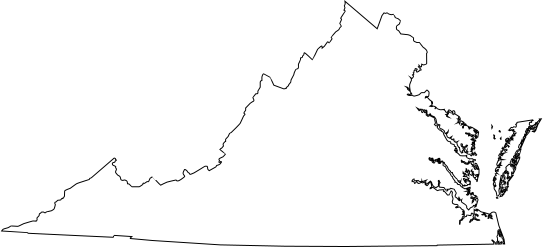
The Virginia Republican Party used ranked choice voting to nominate Glenn Youngkin in a crowded field of five candidates. Youngkin became the first Republican to win a statewide office in 12 years. Both parties have used ranked choice voting to nominate the strongest candidate to represent their voters.
Better Ballot Iowa is already making progress at the statehouse, in city halls, and in communities across Iowa.
Join nearly 7,000 Iowans who are ready for something better.
Join the Movement